

Photobiomodulation LED Therapy in Feline Chronic Kidney Disease: A 15-Month Clinical Study
Abstract
Chronic Kidney Disease (CKD) is a common condition in senior cats, often managed through supportive care aimed at slowing progression and improving quality of life. This study evaluated the adjunctive use of photobiomodulation (PBM) with a home-use LED device (MedcoVet Luma) in feline patients with CKD. Twenty-nine cats with stage II–IV CKD were enrolled. Owners administered PBM therapy every other day according to a standardized protocol, while all patients continued standard veterinary care. Laboratory monitoring and quality-of-life assessments were performed throughout the 15-month period. Nineteen cats completed the study and were included in the final analysis. Results demonstrated that 58% of patients experienced ≥10% reductions in creatinine, 32% maintained stable values, and 10% experienced increases. Quality-of-life improvements were reported in the majority of cases. These findings suggest that adjunctive at-home PBM therapy may provide clinical benefit in the management of feline CKD.
Introduction
CKD is a leading cause of morbidity and mortality in senior cats. Current management strategies focus on dietary adjustments, phosphate binding, and pharmacologic support to slow disease progression. Photobiomodulation therapy has been investigated in a range of chronic conditions due to its effects on mitochondrial activity, circulation, and inflammation modulation. The present study aimed to evaluate the impact of adjunctive LED-based PBM therapy in cats with CKD stages II–IV.
Materials and Methods
Subjects
Thirty-six feline patients were screened. Seven were excluded prior to enrollment, resulting in 29 cats (ages 9–19 years) with confirmed stage II–IV CKD (based on laboratory data within 30 days of enrollment).
Treatment Protocol
Owners administered PBM therapy at home using the MedcoVet Luma LED device every other day, following a standardized dosing protocol provided by the investigator.
Standard Care
All cats remained on their established CKD management plans, including renal diets, phosphate binders, supplements, and prescribed medications under the guidance of their primary veterinarians.
Monitoring
Laboratory evaluations were performed every 3–4 months, and owners completed structured quality-of-life assessments at the same intervals.
Study Duration
The trial duration was 15 months.
Results
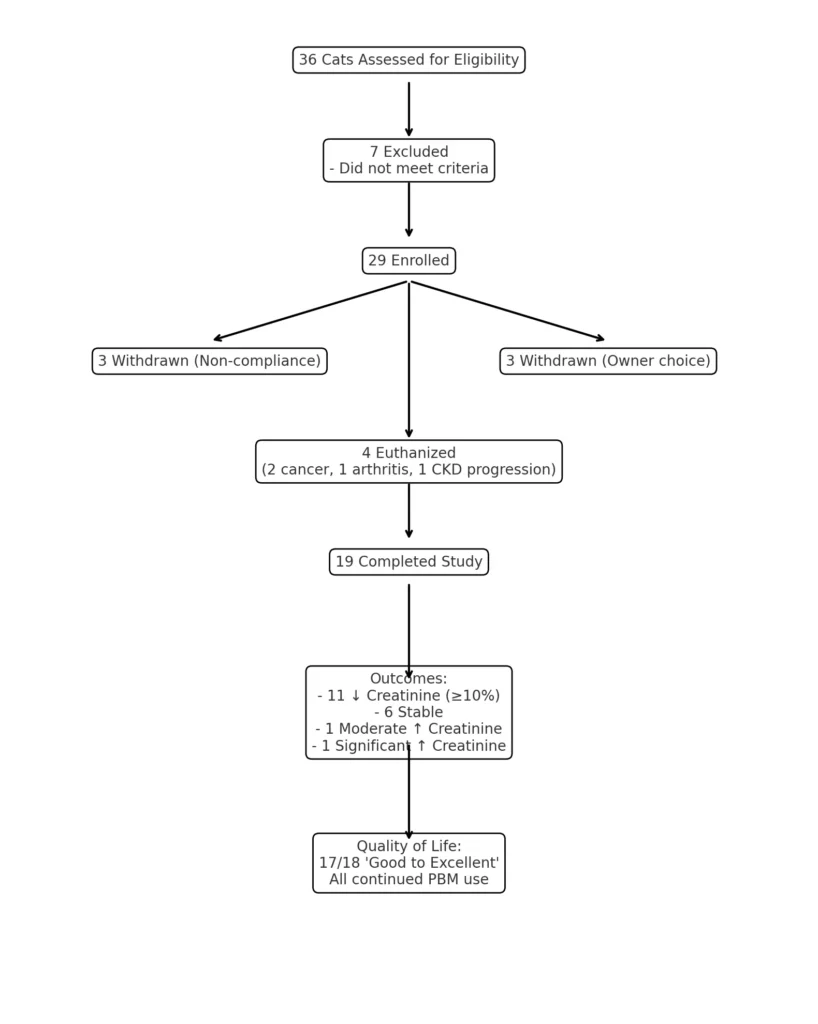
Patient Flow
Of the 29 cats enrolled, 10 did not complete the study:
- 3 were withdrawn due to non-compliance with treatment protocol.
- 3 were withdrawn at owner request (time constraints or patient resistance).
- 4 were euthanized during the study period (2 due to unrelated neoplasia, 1 due to advanced arthritis, 1 due to CKD progression).
A total of 19 cats (65.5%) completed the study and were included in the final analysis.
Laboratory Outcomes
- 11/19 cats (58%) demonstrated a ≥10% reduction in serum creatinine.
- 6/19 cats (32%) maintained relatively stable creatinine values.
- 1/19 cats (5%) showed a moderate increase.
- 1/19 cats (5%) exhibited a sharp increase and was euthanized due to CKD progression.
Quality of Life
Of the 18 cats surviving to study completion, 17 (94%) were rated by their owners as having good to excellent quality of life. Owners of all surviving cats elected to continue PBM therapy beyond the study period.
Discussion
Stabilization of serum creatinine in feline CKD is uncommon, as the disease typically progresses with steady increases in renal values over time. The observed reductions in creatinine in over half the cohort suggest a potential renal-protective effect of adjunctive PBM. Importantly, quality-of-life assessments indicated consistent maintenance or improvement, a critical metric in chronic disease management.
While dropout due to compliance and unrelated health issues is consistent with feline clinical studies, it underscores the need for practical, owner-administered treatment protocols.
Conclusion
Adjunctive PBM therapy with the MedcoVet Luma LED device, when integrated into standard CKD management, demonstrated stabilization or improvement of renal function markers in the majority of feline patients and improved quality-of-life outcomes. Further controlled trials with larger cohorts are warranted to validate these findings.
🐾 Ready to Take the Next Step?
Whether you’re just learning or ready to act — we’ve got you.
👉 Book a Free Consult
Talk to a licensed clinician about your pet’s condition and get a personalized plan. No pressure, just real help.
👉Learn More About the Luma
Explore how our at-home red light therapy device works, why it’s different, and what it can do for your pet.

About the Author
Alon Landa is the CEO and co-founder of MedcoVet, a leader in at-home red light therapy for pets. With over 20 years of experience in medical technology and firsthand involvement in developing the Luma, Alon combines deep technical knowledge with a passion for improving pet health. He regularly collaborates with veterinarians and pet parents to advance photobiomodulation (PBM) care at home.
📍 Based in Boston, MA
📖Read more from Alon here